Rainwater harvesting
Rainwater harvesting design and installation
TerraSetu designs and builds rooftop rainwater harvesting and groundwater recharge systems: filter chambers, recharge pits and recharge bores. We work across Delhi NCR from our base in Gurugram, for houses, builder floors, housing societies, schools, offices and factories, and we repair old systems that have stopped working. Every job comes with a drawing and a bill of quantities priced item by item.
Reviewed by Mohit Parmar, Civil Engineer, TerraSetu · Last checked
What we build
| For | What it usually needs | See |
|---|---|---|
| Houses and builder floors | One recharge point in the setback, with a filter on the downpipes | Cost by plot size in Gurgaon |
| Housing societies | An audit and repair of old pits, new points where needed, and yearly cleaning | Rainwater harvesting for societies |
| Factories, warehouses and campuses | A recharge proposal for groundwater permission, desilting chambers, several pits and bores | Rainwater harvesting for factories |
| Schools and CSR projects | Recharge pits as part of a school building or water project | School buildings |
| Dry borewells | A recharge bore next to the borewell, or a failed borewell turned into one | Borewell recharge |
How the water travels, from roof to aquifer
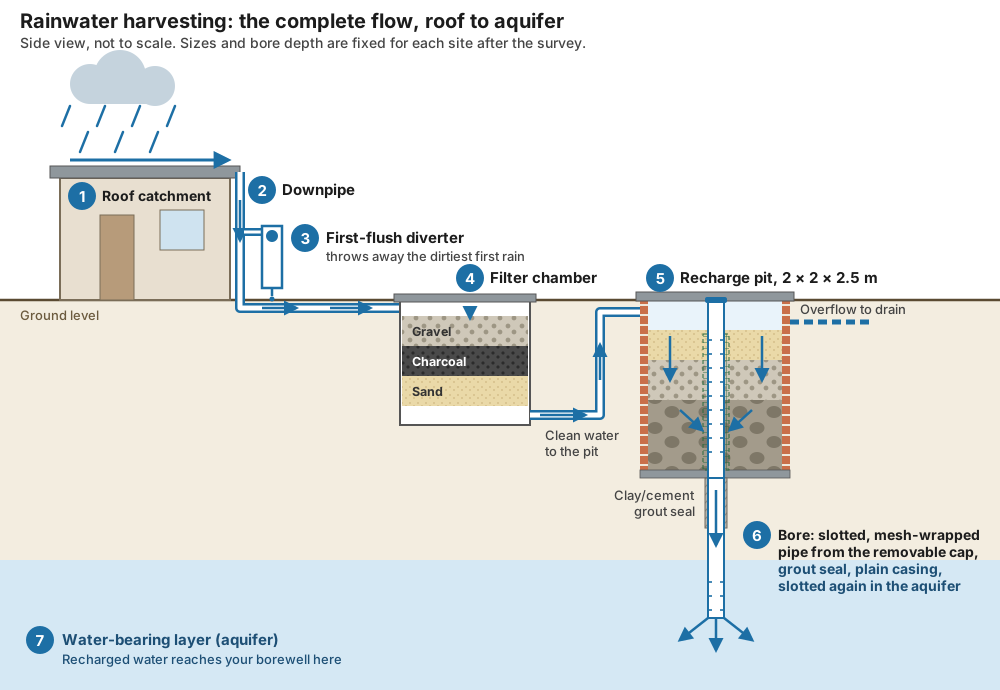
Rain on your roof runs to the downpipe. The first-flush diverter throws away the dirtiest first rain, the filter chamber cleans the rest, and the clean water goes into the recharge pit and down the bore to the water-bearing layer. Any extra overflows to the drain.
The standard design we build
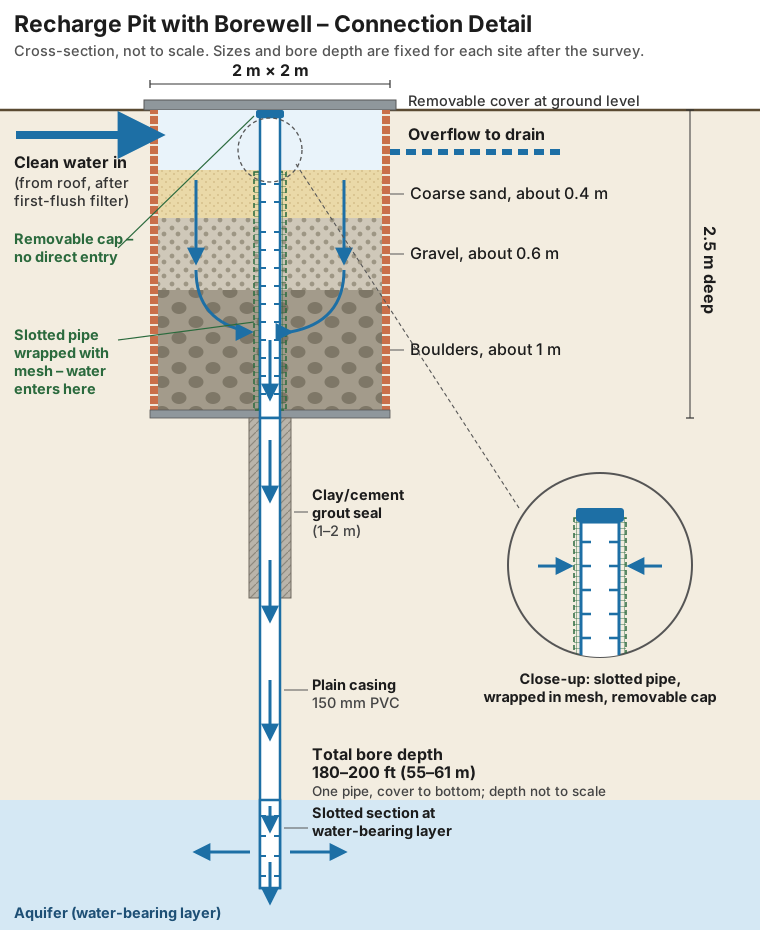
Every recharge point we build follows this design. Roof water passes a first-flush diverter that throws away the dirtiest first rain, then a filter chamber, and enters a brick-lined pit filled with boulders, gravel and coarse sand. At the bottom of the pit it goes into a slotted pipe wrapped in mesh, rising to a removable cap at the cover, down a sealed casing to the water-bearing layer your borewell draws from. The drawing below shows the pit and the pipe connection.
The drawing and the bill of quantities below are what you receive before work starts, sized for your roof after the survey. Check them against any other quote line by line.
Sample bill of quantities for one recharge point in Delhi NCR
| Item | Quantity | Amount before GST |
|---|---|---|
| Recharge pit 2 × 2 × 2.5 m: excavation, honeycomb brick lining, PCC base, RCC cover with manhole | 1 no. | ₹28,000 to ₹38,000 |
| Pit media: boulders, gravel and coarse sand in layers | 1 pit | ₹8,000 to ₹12,000 |
| Recharge bore, 150 mm, with slotted PVC casing (₹300 to ₹500 a foot) | 120 ft | ₹36,000 to ₹60,000 |
| Filter chamber: gravel, charcoal and sand | 1 no. | ₹12,000 to ₹20,000 |
| Downpipe connections, mesh guards, first-flush diverter and overflow | 1 lot | ₹8,000 to ₹15,000 |
| Total before GST | ₹92,000 to ₹1.4 lakh | |
| Total with 18% GST | ₹1.1 lakh to ₹1.7 lakh |
Civil work at the CPWD Delhi Schedule of Rates 2023 plus 10%, the rest at market rates, with a 120 ft bore. A bigger roof needs more pits, but one filter and pipe set can serve several. Price your own roof with the recharge pit calculator.
What a full system costs
Priced with 120 ft recharge bores, typical for most of NCR, and 721 mm of rain a year. For any district in India, see its rainwater harvesting cost page.
| Building | Roof area | Recharge points | Water put back a year | Cost with GST |
|---|---|---|---|---|
| Independent house | 100 m² (1,076 sq ft) | 1 | 61,285 litres | ₹1.1 lakh to ₹1.7 lakh |
| Large house or villa | 250 m² (2,691 sq ft) | 1 | 1,53,213 litres | ₹1.1 lakh to ₹1.7 lakh |
| Small apartment block or office | 600 m² (6,458 sq ft) | 3 | 3,67,710 litres | ₹3.1 lakh to ₹4.8 lakh |
| Housing society, school or factory | 2,000 m² (21,528 sq ft) | 8 | 12,25,700 litres | ₹8 lakh to ₹12 lakh |
Ranges for budgeting, with filter chamber, pit, media, bore and piping. A site survey fixes the design and the price.
The rules in NCR
- Haryana (Gurgaon, Faridabad): Under the Haryana Building Code, 2017, roof rainwater harvesting is required inside the plot wherever the rooftop area is 100 sq m or more. Recharge is mandatory for all building types, including group housing on plots over 500 sq m, and for common open areas such as parks and parking. DTCP has made RWH pits a condition for the occupation certificate. See the Haryana rules.
- Delhi: In Delhi, every new building on a plot of 100 sq m or more must have a rainwater harvesting system, and building plans are not sanctioned without one. Delhi Jal Board withholds new water connections until RWH is certified. Properties of 500 sq m or more without RWH pay a penalty of 1.5 times the water bill, and those with a working system get a 10% rebate on the water bill. See the Delhi rules.
- Uttar Pradesh (Noida, Ghaziabad): Uttar Pradesh requires rainwater harvesting in government buildings and in new buildings above 300 sq m, including group housing and housing schemes. In October 2025 the Chief Minister directed that it be made mandatory for all buildings above 100 sq m, in both urban and rural areas. The implementing bye-law amendment was not confirmed. See the Uttar Pradesh rules.
Where we work
Gurgaon, Delhi, Faridabad and Noida, and on larger jobs across Haryana and North India. In Gurgaon we have separate pages for houses and builder floors, housing societies and factories in Manesar and Udyog Vihar.
Check the numbers for your area
Frequently asked questions
How much does rainwater harvesting cost?
For a house with a 100 m² roof in NCR, about ₹1.1 lakh to ₹1.7 lakh with GST for one recharge point with a 120 ft bore. Larger roofs need more points; see the table above.
What is the difference between a recharge pit and a storage tank?
A storage tank keeps roof water for use, and is full after the first few rains. A recharge pit sends the water into the ground all season, which is what NCR's rules ask for and what helps borewells. Some buildings, especially where water is shallow, use both.
How deep should the recharge bore be?
Deep enough to reach below the water table: about 60 ft where water is shallow, 120 ft in most of NCR, 200 ft or more where it is deep. See your district on the water table pages.
Do you repair old rainwater harvesting systems?
Yes. We desilt pits, replace the filter media, flush or re-drill the recharge bore and add a silt trap, and give you a report with photos for your records.
Our other services
- Rainwater harvesting · Gurugram
Rainwater harvesting in Gurgaon (Gurugram)
Rainwater harvesting in Gurgaon (Gurugram) by TerraSetu: recharge pits and bores for houses, societies, offices and factories. Cost with GST, Haryana rules and OC approval.
- Rainwater harvesting · Delhi
Rainwater harvesting in Delhi
Rainwater harvesting in Delhi by TerraSetu: recharge pits, filters and recharge bores for houses, societies, offices and factories. Cost with GST and the local rules.
- Rainwater harvesting · Faridabad
Rainwater harvesting in Faridabad
Rainwater harvesting in Faridabad by TerraSetu: recharge pits, filters and recharge bores for houses, societies, offices and factories. Cost with GST and the local rules.
- Rainwater harvesting · Noida
Rainwater harvesting in Noida and Greater Noida
Rainwater harvesting in Noida and Greater Noida by TerraSetu: recharge pits, filters and recharge bores for houses, societies, offices and factories. Cost with GST and the local rules.
- Borewell recharge
Borewell recharge
How TerraSetu recharges a failing borewell with roof and yard rainwater: recharge pit, filter and recharge bore. Method, drawing sizes and cost per recharge point with GST.