Rainwater harvesting · Delhi
Rainwater harvesting in Delhi
Delhi made rooftop rainwater harvesting compulsory for plots of 100 m² and more in 2001, yet many systems on paper were never dug or have silted up since. Delhi Jal Board ties both a rebate and a penalty to it, so a working system pays for itself on a larger property. TerraSetu, an engineering and construction firm based in Gurugram, designs and builds rooftop rainwater harvesting and recharge systems across Delhi, and repairs old ones that have stopped working.
Reviewed by Mohit Parmar, Civil Engineer, TerraSetu · Last checked
Why Delhi needs it
- The Central Ground Water Board puts Delhi's groundwater use at 92% of what can safely be taken out each year (2025), which it rates critical. See the groundwater page.
- In CGWB's pre-monsoon readings, most of the 82 monitoring wells in Delhi have water 10–20 m below ground, from 0.71 m (2 ft) in the shallowest to 65 m (213 ft) in the deepest.
- Delhi gets about 803 mm of rain in an average year, 82% of it from June to September. A 100 m² roof can put about 68,255 litres a year back into the ground.
The rules in Delhi
- In Delhi, every new building on a plot of 100 sq m or more must have a rainwater harvesting system, and building plans are not sanctioned without one. Delhi Jal Board withholds new water connections until RWH is certified. Properties of 500 sq m or more without RWH pay a penalty of 1.5 times the water bill, and those with a working system get a 10% rebate on the water bill.
- The rule comes from the Building Bye-laws, 1983 as amended by MoUD (2001); Unified Building Bye-Laws for Delhi, 2016; Master Plan for Delhi 2021.
- Read the full rainwater harvesting rules in Delhi.
What Delhi's buildings need
Most of Delhi's older colonies have small plots and roofs, often 50 to 250 m², with no open ground left. There the recharge point goes under the driveway or the front setback, with a slim filter chamber on the downpipe.
Group housing societies and institutions on 500 m² or more face the 1.5 times water bill penalty if their system is missing. Many have pits that were built for the sanction and have not been cleaned since, so an audit and a repair usually costs far less than the penalty.
What rainwater harvesting costs in Delhi
Priced with 120 ft recharge bores and 803 mm of rain a year. The number of recharge points follows the roof area.
| Building | Roof area | Recharge points | Water put back a year | Cost with GST |
|---|---|---|---|---|
| Independent house | 100 m² (1,076 sq ft) | 1 | 68,255 litres | ₹1.1 lakh to ₹1.7 lakh |
| Large house or villa | 250 m² (2,691 sq ft) | 1 | 1,70,638 litres | ₹1.1 lakh to ₹1.7 lakh |
| Small apartment block or office | 600 m² (6,458 sq ft) | 3 | 4,09,530 litres | ₹3.1 lakh to ₹4.8 lakh |
| Housing society, school or factory | 2,000 m² (21,528 sq ft) | 8 | 13,65,100 litres | ₹8 lakh to ₹12 lakh |
Ranges for budgeting, with filter chamber, pit, media, bore and piping. A site survey fixes the design and the price. See every building size and bore depth on the rainwater harvesting cost page.
How the water travels, from roof to aquifer
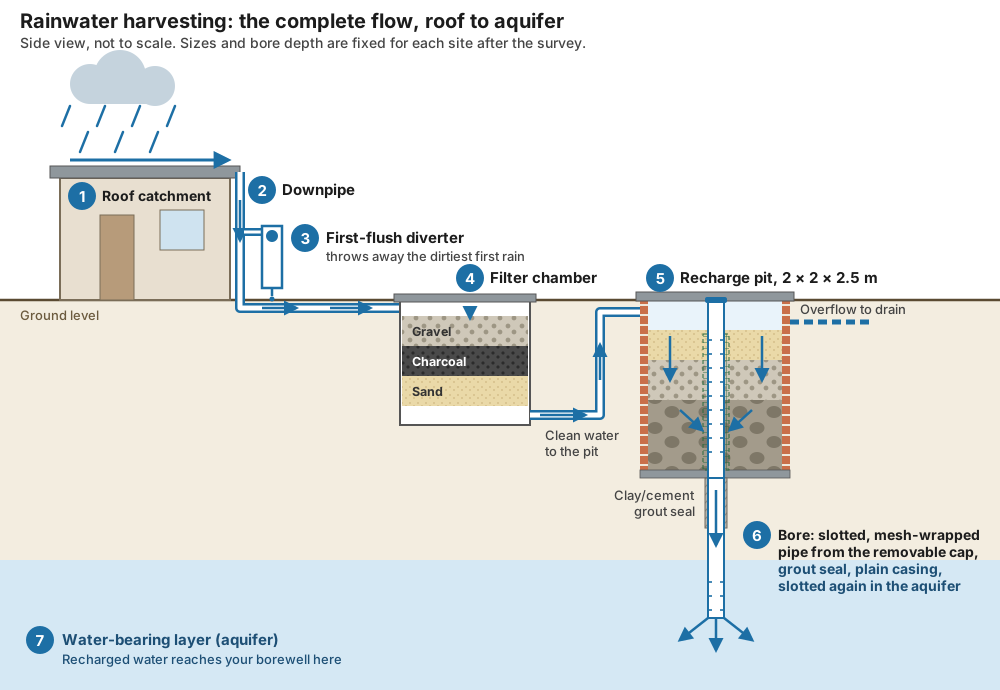
Rain on your roof runs to the downpipe. The first-flush diverter throws away the dirtiest first rain, the filter chamber cleans the rest, and the clean water goes into the recharge pit and down the bore to the water-bearing layer. Any extra overflows to the drain.
The standard design we build
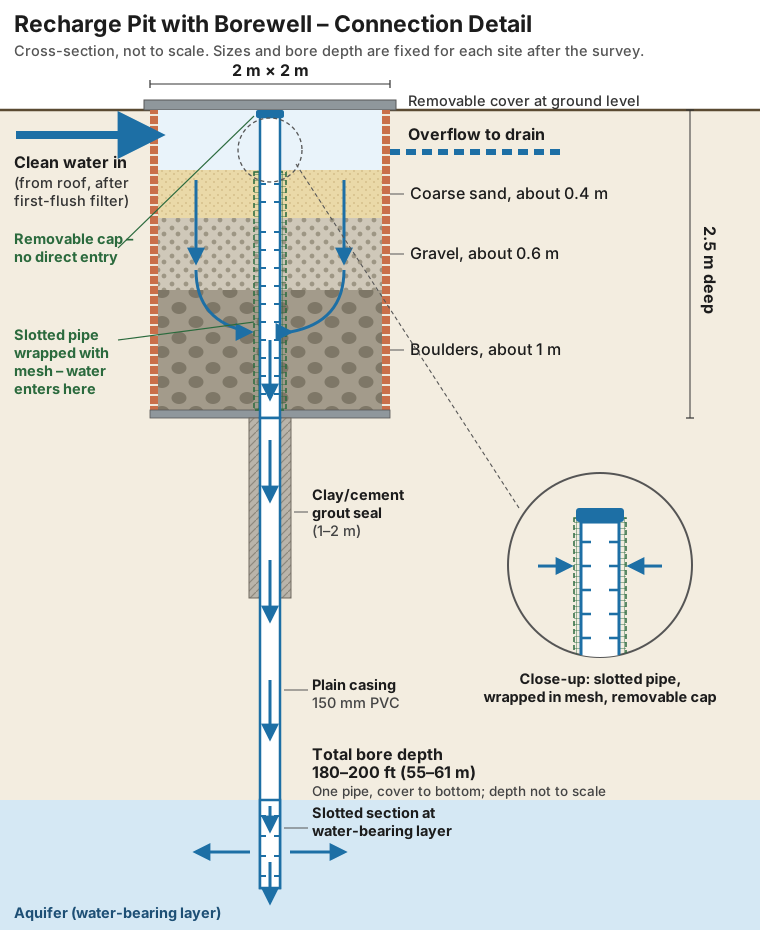
Every recharge point we build follows this design. Roof water passes a first-flush diverter that throws away the dirtiest first rain, then a filter chamber, and enters a brick-lined pit filled with boulders, gravel and coarse sand. At the bottom of the pit it goes into a slotted pipe wrapped in mesh, rising to a removable cap at the cover, down a sealed casing to the water-bearing layer your borewell draws from. The drawing below shows the pit and the pipe connection.
The drawing and the bill of quantities below are what you receive before work starts, sized for your roof after the survey. Check them against any other quote line by line.
Sample bill of quantities for one recharge point in Delhi
| Item | Quantity | Amount before GST |
|---|---|---|
| Recharge pit 2 × 2 × 2.5 m: excavation, honeycomb brick lining, PCC base, RCC cover with manhole | 1 no. | ₹28,000 to ₹38,000 |
| Pit media: boulders, gravel and coarse sand in layers | 1 pit | ₹8,000 to ₹12,000 |
| Recharge bore, 150 mm, with slotted PVC casing (₹300 to ₹500 a foot) | 120 ft | ₹36,000 to ₹60,000 |
| Filter chamber: gravel, charcoal and sand | 1 no. | ₹12,000 to ₹20,000 |
| Downpipe connections, mesh guards, first-flush diverter and overflow | 1 lot | ₹8,000 to ₹15,000 |
| Total before GST | ₹92,000 to ₹1.4 lakh | |
| Total with 18% GST | ₹1.1 lakh to ₹1.7 lakh |
Civil work at the CPWD Delhi Schedule of Rates 2023 plus 10%, the rest at market rates, with a 120 ft bore. A bigger roof needs more pits, but one filter and pipe set can serve several. Price your own roof with the recharge pit calculator.
Where we work
All of Delhi: South and South West Delhi (Vasant Kunj, Dwarka, Mehrauli, Chhattarpur), West and North West Delhi, the DDA group housing societies and the farmhouses. We also work in Gurgaon, Faridabad and Noida.
Check the numbers for your area
Frequently asked questions
How much does rainwater harvesting cost in Delhi?
For a house with a 100 m² roof, about ₹1.1 lakh to ₹1.7 lakh with GST for one recharge point with a 120 ft bore. Societies, offices and factories need several points; see the table above.
Is rainwater harvesting mandatory in Delhi?
In Delhi, every new building on a plot of 100 sq m or more must have a rainwater harvesting system, and building plans are not sanctioned without one. Delhi Jal Board withholds new water connections until RWH is certified. Properties of 500 sq m or more without RWH pay a penalty of 1.5 times the water bill, and those with a working system get a 10% rebate on the water bill.
Who installs rainwater harvesting in Delhi?
TerraSetu, a Gurugram engineering firm, surveys, designs and builds rooftop rainwater harvesting and recharge pits in Delhi for houses, societies, offices and factories, and repairs old pits that have stopped working.
How long does the work take?
A house takes about a week once the drawing is agreed: two or three days for the pit and filter, a day for the bore, and a day or two for the connections. A society or factory with several points takes two to six weeks.
Our other services
- Rainwater harvesting
Rainwater harvesting design and installation
Rooftop rainwater harvesting by TerraSetu: recharge pits, filters and recharge bores for houses, societies, schools and factories in Delhi NCR. Drawings, BOQ and cost with GST.
- Rainwater harvesting · Gurugram
Rainwater harvesting in Gurgaon (Gurugram)
Rainwater harvesting in Gurgaon (Gurugram) by TerraSetu: recharge pits and bores for houses, societies, offices and factories. Cost with GST, Haryana rules and OC approval.
- Rainwater harvesting · Faridabad
Rainwater harvesting in Faridabad
Rainwater harvesting in Faridabad by TerraSetu: recharge pits, filters and recharge bores for houses, societies, offices and factories. Cost with GST and the local rules.
- Rainwater harvesting · Noida
Rainwater harvesting in Noida and Greater Noida
Rainwater harvesting in Noida and Greater Noida by TerraSetu: recharge pits, filters and recharge bores for houses, societies, offices and factories. Cost with GST and the local rules.