Rainwater harvesting · Gurugram · plot size
Rainwater harvesting cost by plot size in Gurgaon
Most people in Gurgaon know their plot in square yards, not their roof in square metres. This page turns one into the other and prices a rooftop recharge system for each common plot size, at Gurugram's 721 mm of rain a year and the 120 ft recharge bores most of the city needs.
Reviewed by Mohit Parmar, Civil Engineer, TerraSetu · Last checked
Cost for each plot size
| Plot | Roof area (about two-thirds of the plot) | Compulsory under the Haryana code? | Recharge points | Water put back a year | Cost with GST |
|---|---|---|---|---|---|
| 100 sq yd (84 m²) | 56 m² (603 sq ft) | Not by roof size, but advised | 1 | 34,320 litres | ₹1.1 lakh to ₹1.7 lakh |
| 125 sq yd (105 m²) | 70 m² (753 sq ft) | Not by roof size, but advised | 1 | 42,900 litres | ₹1.1 lakh to ₹1.7 lakh |
| 150 sq yd (125 m²) | 84 m² (904 sq ft) | Not by roof size, but advised | 1 | 51,479 litres | ₹1.1 lakh to ₹1.7 lakh |
| 200 sq yd (167 m²) | 111 m² (1,195 sq ft) | Yes | 1 | 68,026 litres | ₹1.1 lakh to ₹1.7 lakh |
| 250 sq yd (209 m²) | 139 m² (1,496 sq ft) | Yes | 1 | 85,186 litres | ₹1.1 lakh to ₹1.7 lakh |
| 300 sq yd (251 m²) | 167 m² (1,798 sq ft) | Yes | 1 | 1,02,346 litres | ₹1.1 lakh to ₹1.7 lakh |
| 350 sq yd (293 m²) | 195 m² (2,099 sq ft) | Yes | 1 | 1,19,506 litres | ₹1.1 lakh to ₹1.7 lakh |
| 420 sq yd (351 m²) | 234 m² (2,519 sq ft) | Yes | 1 | 1,43,407 litres | ₹1.1 lakh to ₹1.7 lakh |
| 500 sq yd (418 m²) | 279 m² (3,003 sq ft) | Yes | 1 | 1,70,985 litres | ₹1.1 lakh to ₹1.7 lakh |
| 1,000 sq yd (836 m²) | 557 m² (5,995 sq ft) | Yes | 2 | 3,41,357 litres | ₹2.1 lakh to ₹3.3 lakh |
Roof taken as about two-thirds of the plot, which is typical for a builder floor or kothi; your drawing gives the exact figure. Priced with a 120 ft bore, filter chamber, pit, media and piping. Use the recharge pit calculator for your own roof.
When it is compulsory
Under the Haryana Building Code, 2017, roof rainwater harvesting is required inside the plot wherever the rooftop area is 100 sq m or more. Recharge is mandatory for all building types, including group housing on plots over 500 sq m, and for common open areas such as parks and parking. DTCP has made RWH pits a condition for the occupation certificate. So most plots of about 180 sq yd and more need it for the occupation certificate, and so does any building whose roof reaches 100 m².
Smaller plots are not caught by the rule, but a recharge point next to your borewell is still the cheapest way to slow its decline. Read the full rainwater harvesting rules in Gurugram.
Builder floors and shared roofs
On a builder floor the roof belongs to the top floor or is shared, but the rainwater harvesting requirement belongs to the building. The builder usually puts one recharge point in the front setback, connected to all the downpipes, and the cost is shared across the floors.
If you are buying a floor, ask to see the pit, its filter chamber and the bore. A pit that exists only on the drawing can hold up the occupation certificate for the whole building.
How the water travels, from roof to aquifer
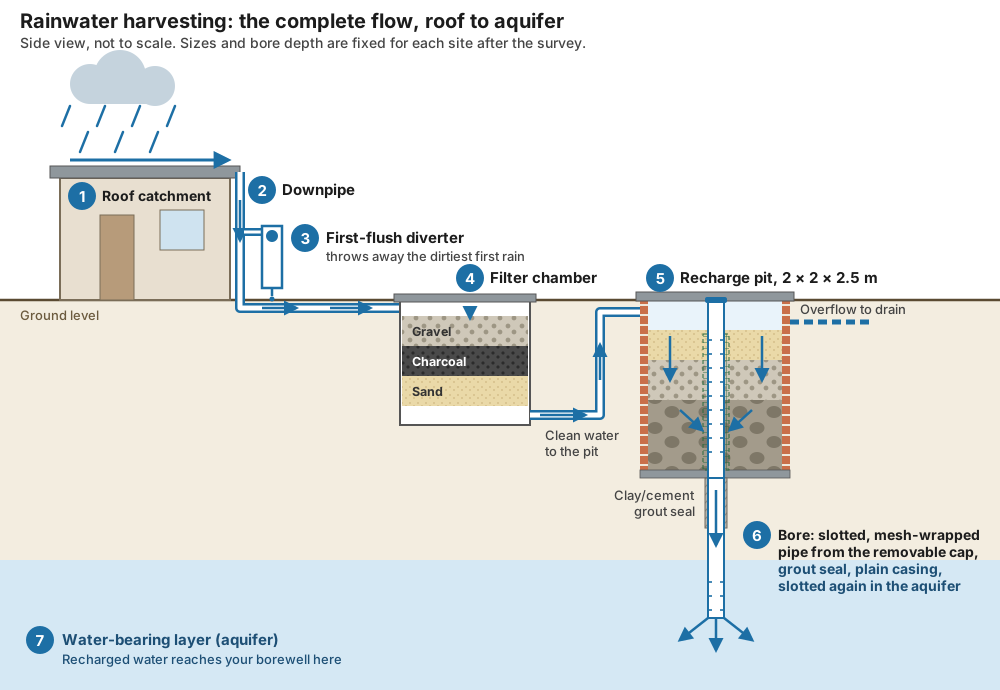
Rain on your roof runs to the downpipe. The first-flush diverter throws away the dirtiest first rain, the filter chamber cleans the rest, and the clean water goes into the recharge pit and down the bore to the water-bearing layer. Any extra overflows to the drain.
The standard design we build
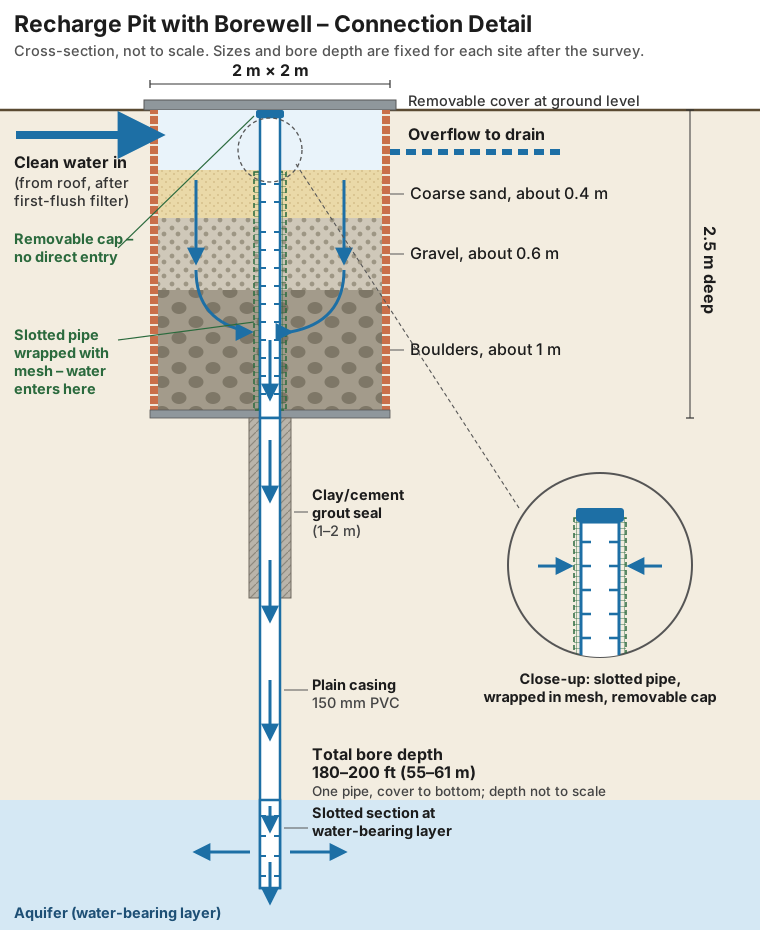
Every recharge point we build follows this design. Roof water passes a first-flush diverter that throws away the dirtiest first rain, then a filter chamber, and enters a brick-lined pit filled with boulders, gravel and coarse sand. At the bottom of the pit it goes into a slotted pipe wrapped in mesh, rising to a removable cap at the cover, down a sealed casing to the water-bearing layer your borewell draws from. The drawing below shows the pit and the pipe connection.
The drawing and the bill of quantities below are what you receive before work starts, sized for your roof after the survey. Check them against any other quote line by line.
Sample bill of quantities for one recharge point in Gurugram
| Item | Quantity | Amount before GST |
|---|---|---|
| Recharge pit 2 × 2 × 2.5 m: excavation, honeycomb brick lining, PCC base, RCC cover with manhole | 1 no. | ₹28,000 to ₹38,000 |
| Pit media: boulders, gravel and coarse sand in layers | 1 pit | ₹8,000 to ₹12,000 |
| Recharge bore, 150 mm, with slotted PVC casing (₹300 to ₹500 a foot) | 120 ft | ₹36,000 to ₹60,000 |
| Filter chamber: gravel, charcoal and sand | 1 no. | ₹12,000 to ₹20,000 |
| Downpipe connections, mesh guards, first-flush diverter and overflow | 1 lot | ₹8,000 to ₹15,000 |
| Total before GST | ₹92,000 to ₹1.4 lakh | |
| Total with 18% GST | ₹1.1 lakh to ₹1.7 lakh |
Civil work at the CPWD Delhi Schedule of Rates 2023 plus 10%, the rest at market rates, with a 120 ft bore. A bigger roof needs more pits, but one filter and pipe set can serve several. Price your own roof with the recharge pit calculator.
Check the numbers for your area
Frequently asked questions
How much does rainwater harvesting cost for a 250 sq yard plot in Gurgaon?
About ₹1.1 lakh to ₹1.7 lakh with GST, for 1 recharge point with a 120 ft bore on a roof of about 139 m².
How much does it cost for a 500 sq yard plot?
About ₹1.1 lakh to ₹1.7 lakh with GST, for 1 recharge point on a roof of about 279 m².
Is rainwater harvesting compulsory for a 125 sq yard plot?
Not by the roof-size rule: the Haryana Building Code, 2017 applies from a roof of 100 m², and a 125 sq yd plot usually has a roof of about 70 m². It is still worth building if you have a borewell.
Can one pit serve the whole building?
On plots up to about 500 sq yd, yes: one pit with a recharge bore takes the water from the whole roof. Larger roofs need a second pit so the water does not overflow in heavy rain; the table shows how many.
Our other services
- Rainwater harvesting · Gurugram
Rainwater harvesting in Gurgaon (Gurugram)
Rainwater harvesting in Gurgaon (Gurugram) by TerraSetu: recharge pits and bores for houses, societies, offices and factories. Cost with GST, Haryana rules and OC approval.
- Rainwater harvesting · Gurugram · societies
Rainwater harvesting for housing societies in Gurgaon
Rainwater harvesting for housing societies and RWAs in Gurgaon: audit of old pits, desilting and repair, new recharge points, yearly maintenance and the groundwater permission.
- Borewell recharge · Gurugram
Borewell recharge in Gurgaon (Gurugram)
Borewell recharge in Gurgaon (Gurugram) by TerraSetu: recharge pit, filter and a 120 ft recharge bore that sends roof rainwater to the layers your borewell draws from. Cost with GST.
- Rainwater harvesting
Rainwater harvesting design and installation
Rooftop rainwater harvesting by TerraSetu: recharge pits, filters and recharge bores for houses, societies, schools and factories in Delhi NCR. Drawings, BOQ and cost with GST.