Rainwater harvesting · Gurugram · industry
Rainwater harvesting for factories in Gurgaon, Manesar and Udyog Vihar
A factory or warehouse roof in Gurugram is large enough to put millions of litres a year back into the ground, and the state's groundwater permission asks for exactly that. Gurugram pumps out 195% of the groundwater that can safely be taken out each year, with water 20–40 m below ground in most monitoring wells. TerraSetu prepares the recharge design that goes with the permission, builds it and keeps it working.
Reviewed by Mohit Parmar, Civil Engineer, TerraSetu · Last checked
Groundwater permission in Haryana
- Under the Haryana Water Resources (Conservation, Regulation and Management) Authority, every industry, infrastructure project and mining project that uses groundwater needs the Authority's permission. Infrastructure includes hospitals, schools, hotels, restaurants, malls, clubs and housing societies.
- Individual households without a public water supply, rural drinking water schemes, the armed forces and farming are exempt. Micro and small units drawing under 10 m³ a day are exempt from permission but must register with the Authority.
- Where the water level is deeper than 8 m, which is most of Gurugram, the application needs a rainwater recharge proposal. Where it is shallower, roof water has to be collected in a lined tank and reused instead.
- The Authority asks for 90 days of groundwater tariff in advance, based on the unit's stated demand, before it issues the permission, and processing takes about a month.
- These points are from the Haryana Water Resources Authority's published FAQ. Check the conditions printed on your own permission, which you must follow.
What we do for a factory
Survey
Roof, shed and paved areas, downpipes and storm drains, existing borewells and their yield, and the soil.
Recharge proposal
A design sized for Gurugram's rainfall: the number and position of recharge wells or pits, the desilting chambers and the bore depth, with drawings and a calculation of the water recharged each year.
Build
Desilting chambers on the storm drains, filter chambers on the roof lines, recharge pits and bores, all built to the drawing, with photos at every stage.
Records
An as-built drawing and photo record for the permission file and for inspections.
Maintenance
Pre-monsoon and post-monsoon cleaning with a short report each time, so the system keeps working and the record stays current.
What it costs
Priced with 120 ft bores and 721 mm of rain a year. Large sheds usually need desilting chambers on the storm drains as well, priced after the survey.
| Building | Roof area | Recharge points | Water put back a year | Cost with GST |
|---|---|---|---|---|
| Society tower block, school or small factory | 2,000 m² (21,528 sq ft) | 8 | 12,25,700 litres | ₹8 lakh to ₹12 lakh |
| Mid-size society or factory | 5,000 m² (53,820 sq ft) | 18 | 30,64,250 litres | ₹18 lakh to ₹28 lakh |
| Large campus, society or plant | 10,000 m² (1,07,639 sq ft) | 36 | 61,28,500 litres | ₹36 lakh to ₹55 lakh |
Ranges for budgeting, with filter chambers, pits, media, bores and piping.
How the water travels, from roof to aquifer
Rain on your roof runs to the downpipe. The first-flush diverter throws away the dirtiest first rain, the filter chamber cleans the rest, and the clean water goes into the recharge pit and down the bore to the water-bearing layer. Any extra overflows to the drain.
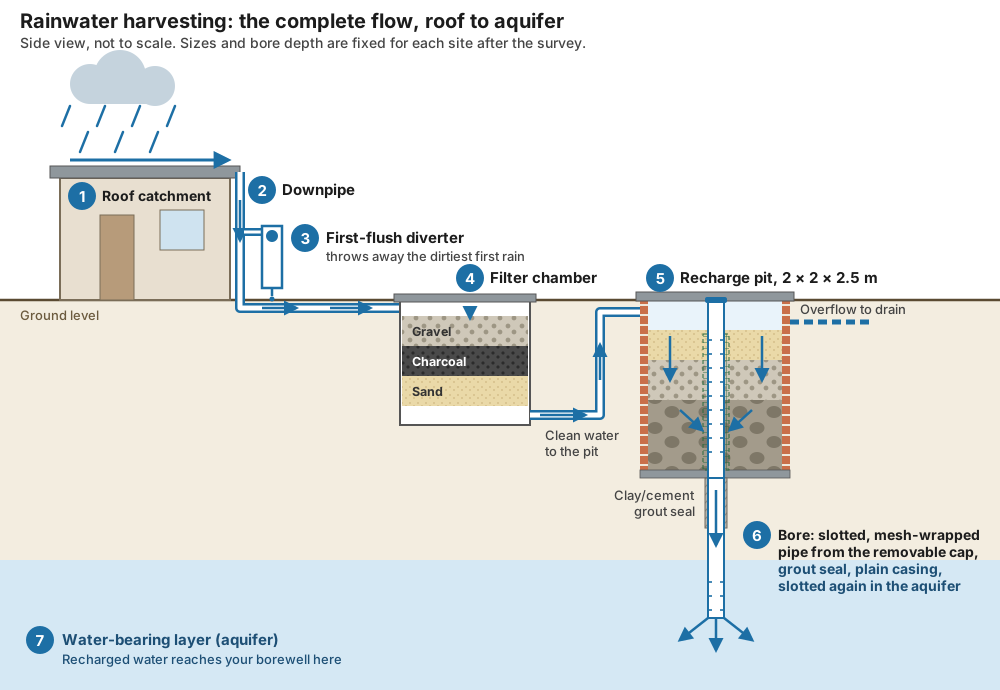
The standard design we build
Every recharge point we build follows this design. Roof water passes a first-flush diverter that throws away the dirtiest first rain, then a filter chamber, and enters a brick-lined pit filled with boulders, gravel and coarse sand. At the bottom of the pit it goes into a slotted pipe wrapped in mesh, rising to a removable cap at the cover, down a sealed casing to the water-bearing layer your borewell draws from. The drawing below shows the pit and the pipe connection.
The drawing and the bill of quantities below are what you receive before work starts, sized for your roof after the survey. Check them against any other quote line by line.
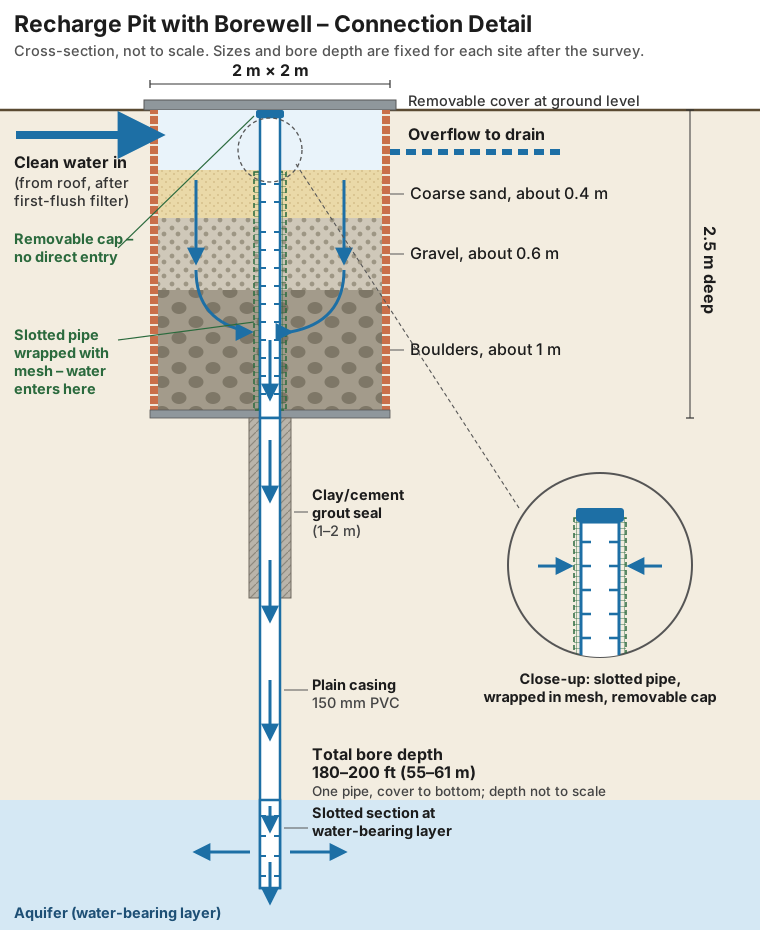
Sample bill of quantities for one recharge point on a factory roof
| Item | Quantity | Amount before GST |
|---|---|---|
| Recharge pit 2 × 2 × 2.5 m: excavation, honeycomb brick lining, PCC base, RCC cover with manhole | 1 no. | ₹28,000 to ₹38,000 |
| Pit media: boulders, gravel and coarse sand in layers | 1 pit | ₹8,000 to ₹12,000 |
| Recharge bore, 150 mm, with slotted PVC casing (₹300 to ₹500 a foot) | 120 ft | ₹36,000 to ₹60,000 |
| Filter chamber: gravel, charcoal and sand | 1 no. | ₹12,000 to ₹20,000 |
| Downpipe connections, mesh guards, first-flush diverter and overflow | 1 lot | ₹8,000 to ₹15,000 |
| Total before GST | ₹92,000 to ₹1.4 lakh | |
| Total with 18% GST | ₹1.1 lakh to ₹1.7 lakh |
Civil work at the CPWD Delhi Schedule of Rates 2023 plus 10%, the rest at market rates, with a 120 ft bore. A bigger roof needs more pits, but one filter and pipe set can serve several. Price your own roof with the recharge pit calculator.
Where we work
IMT Manesar and Manesar, Udyog Vihar, Sector 37 and Khandsa, Daulatabad, Sohna, Bilaspur, Binola, Pataudi and the warehouses along NH-48 and the KMP Expressway. We also work in Faridabad, Noida and Delhi.
Check the numbers for your area
Frequently asked questions
Does a factory in Gurgaon need groundwater permission?
Under the Haryana Water Resources (Conservation, Regulation and Management) Authority, every industry, infrastructure project and mining project that uses groundwater needs the Authority's permission. Infrastructure includes hospitals, schools, hotels, restaurants, malls, clubs and housing societies. Individual households without a public water supply, rural drinking water schemes, the armed forces and farming are exempt. Micro and small units drawing under 10 m³ a day are exempt from permission but must register with the Authority.
Is rainwater harvesting required for the permission?
Where the water level is deeper than 8 m, which is most of Gurugram, the application needs a rainwater recharge proposal. Where it is shallower, roof water has to be collected in a lined tank and reused instead.
How much does rainwater harvesting cost for a factory?
For a 5,000 m² roof, about ₹18 lakh to ₹28 lakh with GST for 18 recharge points with 120 ft bores. Desilting chambers on storm drains are extra and depend on the site.
Can you work while the factory is running?
Yes. Pits and bores go along the boundary, roads and green areas, and we plan the work in sections so loading bays and access stay open.
Our other services
- Rainwater harvesting · Gurugram
Rainwater harvesting in Gurgaon (Gurugram)
Rainwater harvesting in Gurgaon (Gurugram) by TerraSetu: recharge pits and bores for houses, societies, offices and factories. Cost with GST, Haryana rules and OC approval.
- Rainwater harvesting · Gurugram · societies
Rainwater harvesting for housing societies in Gurgaon
Rainwater harvesting for housing societies and RWAs in Gurgaon: audit of old pits, desilting and repair, new recharge points, yearly maintenance and the groundwater permission.
- Sewage treatment plants
Sewage treatment plants for societies, schools and offices
Sewage treatment plants designed and built by TerraSetu: sizing in KLD, MBBR, SBR and packaged plants, State PCB consent, and reuse of treated water for flushing and gardens.
- Rainwater harvesting
Rainwater harvesting design and installation
Rooftop rainwater harvesting by TerraSetu: recharge pits, filters and recharge bores for houses, societies, schools and factories in Delhi NCR. Drawings, BOQ and cost with GST.