- Gurugram
- Ponds
- Groundwater
Gurugram's disappearing ponds: what the records show
Mohit Parmar · · 6 min read
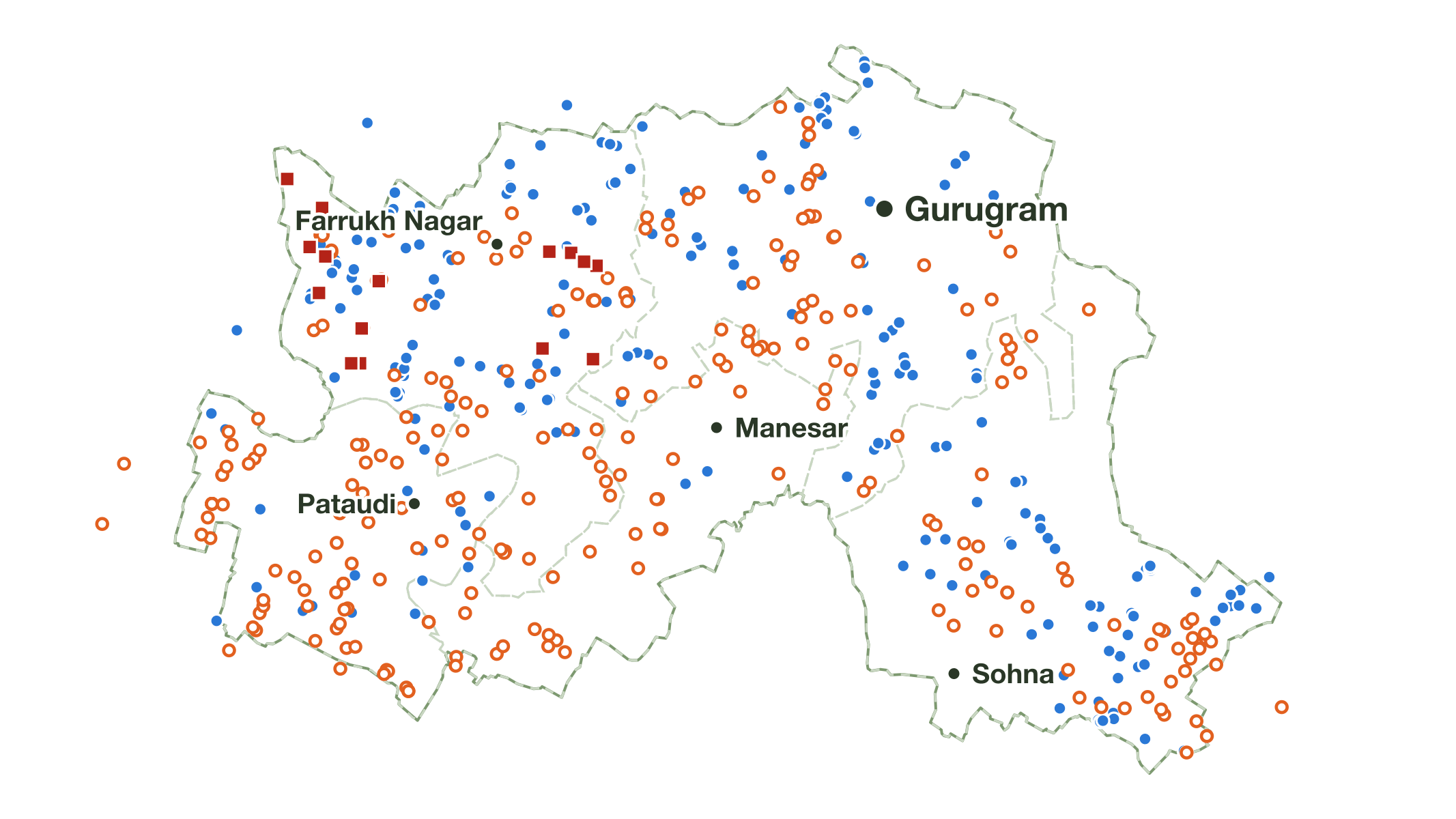
Gurugram pumps out almost twice the groundwater that rain puts back: the Central Ground Water Board's 2025 assessment puts the district at 195% of its safe limit. For centuries its villages relied on ponds, johads and check dams to catch monsoon water and let it soak back into the ground. Most of those ponds are gone, dry or built over. Here is what the official records actually show, and where the ponds that remain are failing.
The record, count by count
Different agencies have counted Gurugram's water bodies in different ways over seventy years, so the numbers can't simply be subtracted from each other. Read side by side, though, they all point the same way.
| Year | Count | Source |
|---|---|---|
| 1956 | 640 water bodies | Revenue records (Record of Rights) |
| 1976 | 519 water bodies | Survey of India maps |
| 2018 | 251 water bodies | Current revenue records, in a district administration study submitted to the National Green Tribunal |
| 2019 | 644 water bodies listed, 153 "practically vanished beyond recovery or revival" | GMDA inventory submitted to the NGT |
| 2021 | 535 water bodies counted, 272 not in use, 15 encroached | 1st Census of Water Bodies (Ministry of Jal Shakti) |
| 2025 | 181 ponds in city records, 65 encroached, only 33 still holding water | Municipal Corporation of Gurugram survey |
Between the 1976 maps and the 2018 revenue records, more than half of the district's water bodies disappeared from the books. The 2019 inventory, which went village by village across all five tehsils, found that nearly a quarter of what it listed could no longer be brought back.
Two counts need a note. The Census of Water Bodies only recorded water bodies in rural Gurugram: all 535 are in villages, none in the city. That gap is filled by the municipal survey, which covers ponds inside city limits. And the Haryana Water Resources Atlas 2025, using satellite images, maps 953 ponds and 245 other water bodies in the district. Satellites pick up every small depression holding water, so that figure measures something different and isn't a sign of recovery.
Where the remaining ponds are failing
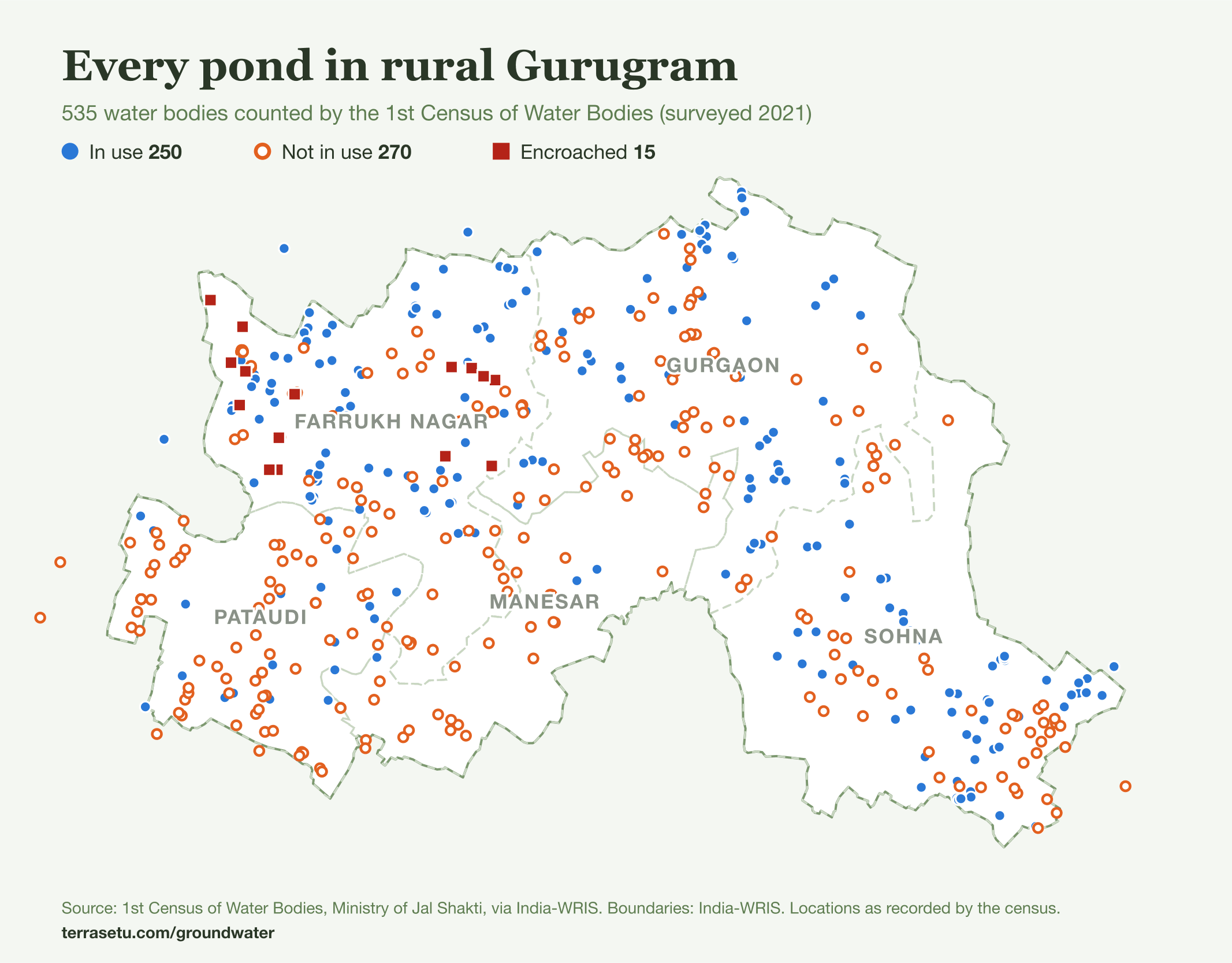
The census also asked whether each water body is still used, for irrigation, cattle, recharge or anything else. Half of Gurugram's are not.
| Block | Water bodies | Not in use | Encroached |
|---|---|---|---|
| Farrukh Nagar | 171 | 60 | 15 |
| Sohna | 134 | 53 | 0 |
| Pataudi | 112 | 89 | 0 |
| Gurgaon | 80 | 35 | 0 |
| Manesar | 38 | 35 | 0 |
| District | 535 | 272 | 15 |
In Manesar, the industrial belt, 35 of 38 water bodies are out of use. In Pataudi it is 89 of 112. A pond that nobody uses stops being desilted, its inlets get blocked, and within a few years it is easy to fill in. All 15 encroachments the census recorded are in Farrukh Nagar; the city survey found encroachment on more than a third of urban ponds, so the true picture is almost certainly worse than the census shows.
Six ponds on the record
Each of these was surveyed by the census team. Open a pin to see the pond in Google Maps, where the satellite view shows what is left of it today. Locations are as the census recorded them, so a pin can be a little off.
Patli Hajipur, Farrukh Nagar. A natural pond on panchayat land, recorded as both encroached and out of use. Open the pin in Google Maps
Siwari, Farrukh Nagar. Another panchayat pond, encroached and no longer used. Open the pin in Google Maps
Gugana, Farrukh Nagar. Encroached, but still recorded as recharging groundwater: exactly the kind of pond worth protecting before it is lost. Open the pin in Google Maps
Shekhupur Majri, Farrukh Nagar. A co-operative pond, still used for recharge, recorded as encroached. Open the pin in Google Maps
Bahora Khurd, Manesar. One of the 35 water bodies in Manesar block that are no longer in use. Open the pin in Google Maps
Bahora Kalan, Pataudi. A natural panchayat pond, out of use like 89 of Pataudi's 112. Open the pin in Google Maps
You can see all 535 on one map, filter the ones not in use, and list the encroached ones on our Gurugram groundwater page.
Why it matters
Ponds did two jobs for Gurugram. They held monsoon water long enough for it to seep into the aquifer, and they took the overflow that now runs down roads. The Tribune's report on the municipal survey found that most encroached ponds lie in areas flagged as waterlogging-prone, and many now sit under shops, temples, schools and community centres. Meanwhile the water table keeps falling, because every pond that is lost is a recharge point that no longer exists.
What works
Revival is possible. Wazirabad lake, an 18-acre water body in the city, was restored from 2022 by GMDA with the non-profit SEEDS: about 500 truckloads of construction debris were removed, and a 1.5 MLD water line laid by the municipal corporation keeps it topped up. According to Down To Earth, 45 of the metropolitan area's 75 identified lakes are now being restored by GMDA with non-profit partners. The 2019 inventory found 446 water bodies across the district that could still be revived.
For a village pond, the work is usually straightforward:
- Desilt the bed and repair the bunds, so the pond holds water through the dry months.
- Reopen the inlets and the drains that once fed it, and add silt traps so it doesn't fill up again.
- Add recharge shafts or wells in the bed where clay sits on top of sandier layers, so stored water actually reaches the aquifer.
- Mark and protect the boundary using revenue records, before it is encroached.
Terrasetu builds this kind of work for panchayats, companies and the NGOs running their CSR programs: pond revival, recharge structures and rooftop rainwater harvesting. If you are planning a project in Gurugram, get in touch.
Sources
- District administration study submitted to the NGT, reported in the Times of India: Gurgaon lost 389 water bodies in 60 years (22 January 2018) and How half of Gurugram's water bodies vanished in 40 years (13 June 2018)
- GMDA inventory and Wazirabad lake: Down To Earth, Gurugram has revived its Wazirabad lake (18 June 2025)
- Municipal survey: The Tribune, 65 of 181 ponds encroached in Gurugram (1 October 2025)
- 1st Census of Water Bodies, Ministry of Jal Shakti, via India-WRIS
- Haryana Water Resources Atlas 2025, ponds and water bodies
- Central Ground Water Board, Dynamic Ground Water Resources of India 2025
More from the blog
How to Recharge a Dry Borewell: Methods, Cost and Mistakes to Avoid
A borewell goes dry because the water table falls below the pump. Here is how a recharge pit and recharge bore put rainwater back, what it costs in 2026 and the mistakes that ruin a bore.
Gurugram's Groundwater Crisis: Why the Water Table Keeps Falling
Gurugram pumps almost twice the groundwater the monsoon puts back: 195% in the 2025 CGWB assessment. What the numbers show, why the water table keeps falling, and what actually helps.
Borewell Permission in Haryana: HWRA NOC, Rules and Dark Zones (2026)
Do you need permission for a borewell in Haryana? Who needs an HWRA NOC, who is exempt, what dark zone status changes, the ₹1 lakh late fee, and the recharge conditions that come with it.